
For international Solidarity!
N O W is the postal vote for the Academic Senate (AS)
Students at German universities have the right to vote and to be represented on all university committees.
All students, even those without a German passport!
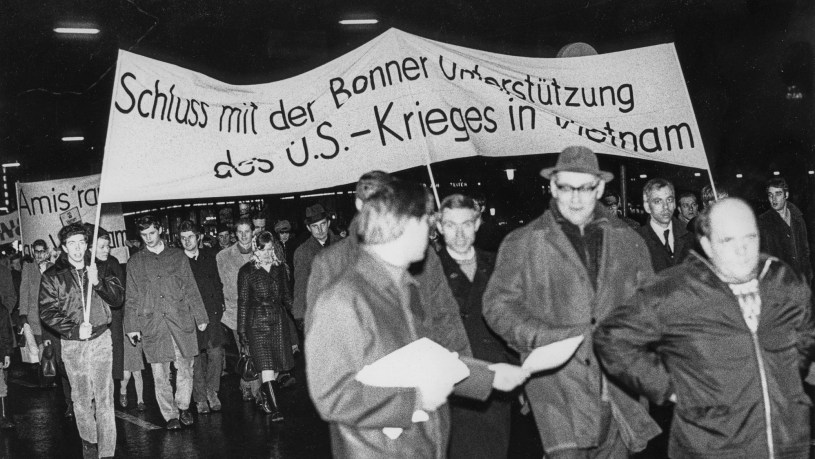
This democratic right is an achievement of the student revolt of the 1960s. Before that, West German universities were ‘governed’ solely by professors, quite a few of whom were still Nazis or very conservative. The student movement brought a breath of fresh air to society and universities worldwide. The starting point was an outrage at the double standards: ‘freedom and democracy’ in the USA, France and West Germany, behind which stood a long continuity and presence of violence, racism, imperialist warfare (Vietnam, North-West Africa) and the pursuit of profit.
Growing contradictions in the universities
The situation today is comparable. The prevailing view is that universities should be ‘learning factories’ in order to provide highly qualified labour for private companies and the state. Academic freedom is being restricted, especially when it comes to peace and human rights for all. There is little room for empathy, personal fulfilment, solidarity and science with global responsibility.
But at the same time, the human community needs scientific contributions to crisis resolution more urgently than ever: we must contribute to overcoming war and confrontation, inequality, involuntary migration and climate change and make the planet a place where everyone can live well and peacefully. To achieve this, education as a scientific appropriation of the world is indispensable for the humane shaping of living conditions. Conformist everyday life is unbearable; it can and should be abandoned.
As in the 1960s, it is left-wing and international students today who are raising this challenge of the times in the universities and are therefore fighting for a better social situation for students, for academic freedom and peace research and for genuine democratic participation. These struggles must become more lively, more demanding and more co-operative; everyone should take part. Get informed and get involved!
Strengthen peace research and academic freedom!
This is all the more necessary as the EU Commission and the Federal Ministry of Science are now exerting pressure on the universities in order to increasingly utilize them for economic location security and military armament. The civilian character of research and teaching that has been fought for is to be undermined by mixing ‘civilian’ and ‘military’. In particular, the allocation of public third-party funds (research funds awarded in competitions) and the restriction of scientific co-operation with universities of – from a Western perspective – ‘wrong’ nations (including China, Russia and Iran) are intended to serve this purpose. The ‘civil clause’ fought for by students, which commits universities to researching and teaching for peaceful purposes, is also under political pressure.
In contrast, people are also organizing at our university and in friendly research institutions (e.g. DESY) to defend and improve the civil, internationalist and humanist content of education and science. This includes campaigns for the preservation of ‘civil clauses’, for ‘academic freedom’ with responsibility for peace and equal human rights (also in Israel/Palestine), for needs-based state funding, fair working conditions and BAföG for all.
Use your democratic rights! Unlike in many other countries, there are good, hard-won democratic opportunities here to organise, inform and openly stand up for them. We should all make use of these opportunities.
In this situation, elections to the Academic Senate (AS) will take place from mid-December 2024 to 20 January 2025. The AS is the highest university body. In it, students, academic staff and other employees jointly decide on the organization of the university and the content of studies, teaching and research. The University President is also elected here.
In the Academic Senate, for example, there are controversial discussions:
- Do we have to adapt the university to the poor state funding? Or do we fight together for better conditions?
- Are we practicing self-censorship and subordinating the sciences to geopolitical confrontation?Or are we defending scientific freedom and advocating (peace-promoting) scientific cooperation?
- Should the university pursue a history policy that is purely focussed on remembrance?Or do we cultivate a historically aware culture and science that critically examines the responsibility of universities in Nazi rule and colonial exploitation and draws current conclusions from this?
- Is social selection and injustice acceptable? Or does the university have a responsibility to improve the social situation of non-professorial staff and students?
Choose to become active yourself!
Four different lists are running: the ‘Bündnis für Aufklärung und Emanzipation (BAE!) – List 1’ (left-wingers from various parties, trade unions, subjects and countries), ‘Jura, WiWi, RCDS and LHG – List 2’ (right-wing conservatives), ‘CampusGrün – List 3’ (genuine Greens) and ‘Linke Listen und Klimabündnis – List 4’ (statist ‘left-wingers’). It is important to vote informed!
You will often see active students at information tables who you can talk to. A careful conversation will quickly reveal who is serious about what!
There are also flyers, programs and election newspapers, election videos and information about the candidates under ‘Wahlwerbung’ here:
https://www.kus.uni-hamburg.de/themen/recht/wahlen/akademischer-senat.html
Voting for the Academic Senate (AS) – How does it work?
The Academic Senate is the highest body of the university. It is involved in the election of the University Executive Board, discusses all fundamental issues of university development and the situation and interests of its members. The AS has decision-making rights (e.g. with regard to examination regulations, allocation of funds, mission statements, working conditions, strategic planning of the university, etc.). The AS is made up of 10 professors, 3 students, 3 academic staff and 3 members of the technical, administrative and library staff. The student representatives are elected annually. The election is a postal vote. The election documents, including a prepaid envelope, will be sent to you by the university. If you have not received any documents or have received incorrect documents, you can have them returned to the electoral office by 1.30 p.m. on 20 January 2025. The completed election documents must be received by the Electoral Office by 2 p.m. on 20 January 2025 at the latest. The electoral office is located at Mittelweg 177, rooms S 4061 and 4058, 20148 Hamburg.
The Department for International Students (RIS) meets on Wednesdays at 7 pm in the AStA (room 0042). Feel free to contact us at ris@asta.uni-hamburg.de and follow us on Instagram @risinnen.
 Referat Für Internationale Studierende (RiS)