
All students at the University and the Studienkolleg are called to vote. Everyone can vote – regardless of their passport!
At our university, which partly emerged from a ‘colonial institute’, the student movement was and is motivated by international solidarity and linked to the peace movement.
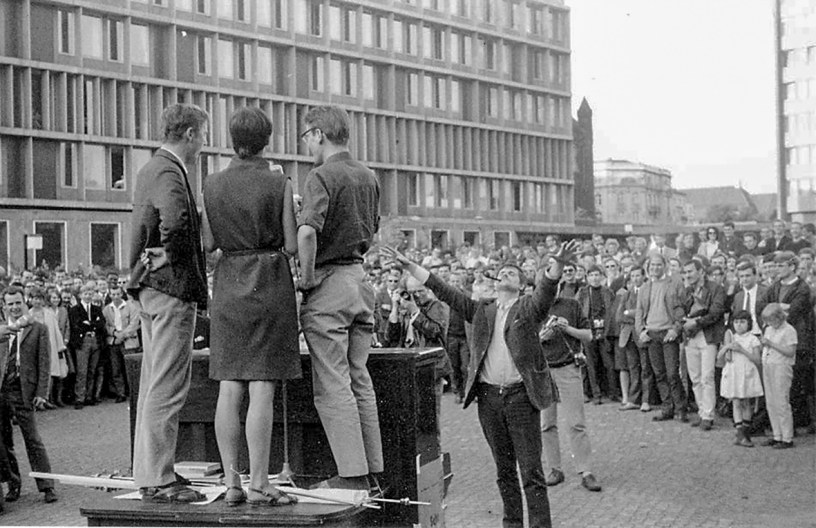
In the 1960s, student activists established the unity of social liberation struggles:
For example, students raised awareness about the US Vietnam War and supported the left-wing opposition from Iran or Greece. They denounced the involvement of West Germany (economy, media, politics…) in global injustice – and at the same time help the US soldiers stationed in West Germany to desert.
In seminars and lectures, day and night, on campus and in pubs, people questioned, discussed, created and practiced the unconventional. ‘Critical universities’ were created. Teaching and studying should make sense: for a better life for all, for justice, for understanding, for peace.
Democracy was brought to life. As an ‘extra-parliamentary opposition’, students and trade unions jointly overcame the narrow paths of representation and expanded co-determination in educational institutions and companies. Universities had to be opened up socially so that the vast majority – unencumbered by hardship – could learn independently, critically and in solidarity and shape society.
The results of these struggles in West Germany included the development of peace research and international responsibility in the sciences, anti-fascist enlightenment throughout society, a profound cultural opening (from costume to miniskirt, from suit to parka, from formal „Sie“ to an equal „Du“, from nuclear family to flat-sharing community…), the abolition of tuition fees, a state student grant as a full subsidy, which 47 per cent of students received (today only 12-15 per cent still receive ‘BAföG’ – as a loan! ).
One key result was the democratization of universities with extensive opportunities for student interest representation and self-organization – with student councils, AStA and also the student parliament.
Since the 1990s, these achievements have been under pressure from right-wing hegemony.
We all urgently need a renewal of critically engaged student life and politics. This is already happening in many places around the world – from Indonesia to the USA, students are the most active part of society in favour of progressive change – from the anti-fascist struggle for democracy to the commitment to free tuition and solidarity with Palestine.
We have a student poverty rate of around 70 per cent here. The universities are severely underfunded. Subjects such as international law, labour law, criminology, the critical ‘Post-Colonial’ studies or even sufficient German courses are minimised in favour of market-conforming science. The confrontation between ‘Western values’ and ‘the rest’ finds its way into research and teaching when academic co-operation is interrupted or subordinated to geopolitical interests. The freedom of science and the democratic openness of universities have long been called into question not only in dictatorships: the new German government is planning to integrate universities into an overall societal war effort for
which billions of euros could suddenly flow.
The university must take its global social responsibility for overcoming profit interests, power politics and violence seriously again and assert itself against austerity dictates and militarisation plans. The student body is the main driving force behind this!
The importance of our commitment to social development, to overcoming the climate crisis, to eliminating hunger, misery and poverty, to de-escalation and disarmament and to an enlightened, socially aware culture is growing. The ambition to contribute to this must be the guiding principle for the next student parliament, the AStA and the entire student body.
This election is crucial!
What is the Student Parliament (StuPa)?
The student parliament is the main body representing the interests of students for students. This parliament elects the General Students‘ Committee (AStA), discusses and decides on political positions and decides on student body campaigns. It also has the budget for the student representation of interests.
How do you get informed?
There are leaflets and programme statements as well as election newspapers and an election-o-mat. It’s good to talk to active students, who you can see at information tables on campus every day during the election. Careful reading and open discussion will quickly reveal who is serious about what!
When and where can you vote?
The election is divided into two voting periods. The postal vote option has ended. You can now cast your vote directly at the ballot boxes from 12 to 16 May between 9:30 am and 6 pm. Please go to the ballot boxes in the central foyers of the university buildings. You only need to bring your student ID with you!
Information from the student parliament: https://stupawahl-uni-hamburg.de/
 Referat Für Internationale Studierende (RiS)